
Introduction to Academia Historica
Academia Historica was established in Nanjing in January 1947 and relocated to Taiwan in 1957. Operating under the Presidential Office, it encompasses Taiwan Historica and is dedicated to researching and preserving the rich heritage of the nation’s and Taiwan’s history. In 2004, with the enactment of the Presidential and Vice Presidential Records and Artifacts Act, it became the official custodian of the Presidents’ and Vice Presidents’ artifacts, responsible for archiving their audio-visual materials, speeches, and gifts.
Through its extensive collection and the organization and maintenance of historical documents and artifacts, Academia Historica ensures public accessibility and engagement. With exhibitions, research, publications, and database development, it not only showcases the nation’s history but also plays a pivotal role in preserving the narrative of its evolution.
 |
In 1998, Taipei City Government designated this building as a municipal historic site. In 2006, the Ministry of Transportation and Communications was relocated, and the building was repurposed by Academia Historica. |
Archival and Artifact Collection
The institution is home to an extensive collection of archives and artifacts, sourced from both government bodies and private donors. Highlights include the renowned Daxi Archives, a collection of documents compiled by aides to former President Chiang Kai-shek, as well as the personal diaries of Chiang Kai-shek and Chiang Ching-kuo, along with early government records.
Among our collection are pivotal historical documents, some of which are recognized as national treasures or significant antiquities. These include the Constitution of the Republic of China, the Japanese Instrument of Surrender, and the Act of Surrender—China Theatre. These documents provide invaluable insights into key government decisions and the socio-economic evolution of our nation, making them essential sources for the study of modern and contemporary Taiwanese history.
Our collection of artifacts is equally remarkable, featuring historically significant items such as the Seal of the President, a national treasure crafted following the enactment of the constitution. The Stamp of the President, notable for being the first of its kind produced in Taiwan, and President Chiang Kai-shek’s Baton, an emblem of its era, are also key pieces. In addition, our collection is enriched by medals and gifts bestowed upon presidents and vice presidents during diplomatic missions and encounters with both domestic and international dignitaries.
We manage these archives and artifacts with utmost care to meet their specific needs. Methods employed to ensure the long-term preservation of these valuable holdings include pest control, cleaning, restoration, mounting, cataloging, and digitization. These measures not only safeguard our historical treasures but also prepare them for public access and future educational purposes.
 |
Constitution of the Republic of China |
Reader Services
In line with open-government initiatives, our institution offers an online inquiry platform, the Academia Historica Collections Online System, that enables users to easily search for our catalog of archival materials and artifacts, and view images of these items. This user-friendly system provides comprehensive information on our collections, available for browsing and downloading. Researchers can begin by exploring our digital collections through the system and then either access available archives directly online or apply to view them in person at our Digital Archive Reading Room in the Taipei branch, or at the Original Archive Reading Room in the Xindian branch.
Our Taipei branch also boasts an open-access library that houses a wealth of research materials on modern history, periodicals, and various publications produced by our institution over the years.
 |
Reading room |
Exhibition and Outreach Activities
At the Taipei branch, we host a dynamic physical exhibition space. It features artifacts from former presidents and vice presidents, with a focus on gifts received from foreign states and members of the public. The permanent exhibition “Life of the Architecture” delves into the history of our heritage building, dating back to 1924. Special exhibitions, such as “Elections in Taiwan: Past and Present,” “The Essential 1991: Lee Teng-hui and the First Year of the Taiwan Democracy Era,” and “Exhibition on A Retrospective of Post-War Taiwan-U.S. Relations” use archival and historical materials to chart Taiwan’s democratization and development.
“The Bright Field of Inherit History All-Digital Exhibition Platform” showcases our exhibitions and collections in an all-digital format, extending restriction-free access to a global audience.
The Taipei branch also hosts lectures on archives, artifacts, and historical subjects, along with various regular and occasional academic events, including seminars, book launches, and panel discussions.
 |
A corner of the “19 Anecdotes on Tea” exhibition |
Publications
Our institution plays a key role in compiling the national history and researching presidential and vice-presidential records. We are dedicated to publishing a diverse range of historical compilations, oral histories, and historical monographs, all aimed at enhancing the accessibility and application of our collections in order to meet public information needs.
In line with Open Government and Transitional Justice policies, we have published a series of books on significant post-war Taiwanese political events. These include documentary collections about the 228 Incident, Kaohsiung Incident, Chen Wen-chen Case, Declaration of Formosan Self-Salvation Case, the Presbyterian Church in Taiwan Case, and Select Documents on U.S. National Security and Taiwan Policy in Translation. In addition, we have produced oral histories, including titles such as An Oral History of People Related to Gikong Church, An Oral History of People Related to Overseas Taiwan Independent Movement. Presidential Collections include The Reminiscences of President Lee Teng-hui by His Staff & Fellow, Interviews with President Chen Shui-bian, Chiang Kai-shek Diaries, and Chiang Ching-kuo Diaries.
Our collaborative efforts extend to academic institutions both in Taiwan and abroad. Notably, we have signed academic exchange MOUs with the Hoover Archives at Stanford University and the National Institute of Korean History. These partnerships have facilitated the publication of important works such as The Diaries of Taiwan Garrison Commander General Huang Chieh. We also edit and publish an academic journal, the Bulletin of Academia Historica, which has been included in the Taiwan Humanities Core Index (THCI).
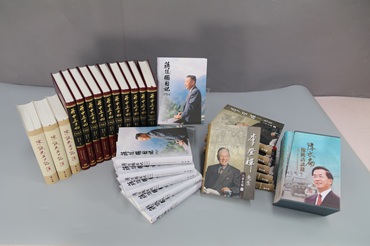 |
Presidential Collections |
Presidential Databases
Adapting to the needs of the digital era, our institution has undertaken the significant task of creating a digital presidential library. This ambitious initiative involves collating archives and historical materials related to former presidents, along with a wide range of important written and audio-visual materials, such as published works, diaries, speech compilations, detailed records of significant events, and oral interviews.
This comprehensive collection is thoughtfully integrated using information technology to set up themed databases which present in chronological order the personal lives, historical contexts, major activities, and key achievements of each president, thus offering the public a detailed perspective on the nation’s history through the experiences of its leaders.
Since 2020, we have been methodically developing the Presidential Databases portal and its corresponding individual presidential databases. The President Chiang Ching-kuo Database was launched in January 2022, followed by the unveiling of the President Lee Teng-hui Database in July 2023. Looking ahead, we plan to continue to expand these databases, showcasing the wealth of information in our archival materials and artifacts and making them a vital resource for various sectors.
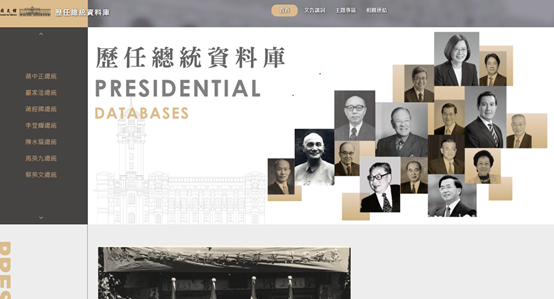 |
Presidential Databases portal |
Organization

Academia Historica is organized into four departments and three offices, namely: the Department of Compilation and Research, the Department of Preservation and General Service, the Department of Acquisition, and the Department of Secretariat; as well as the Personnel Office, the Accounting Office, and the Civil Service Ethics Office. In 2002, the former Provincial Documents Committee of Taiwan was renamed "Taiwan Historica" and incorporated into Academia Historica as a subordinate agency.
